
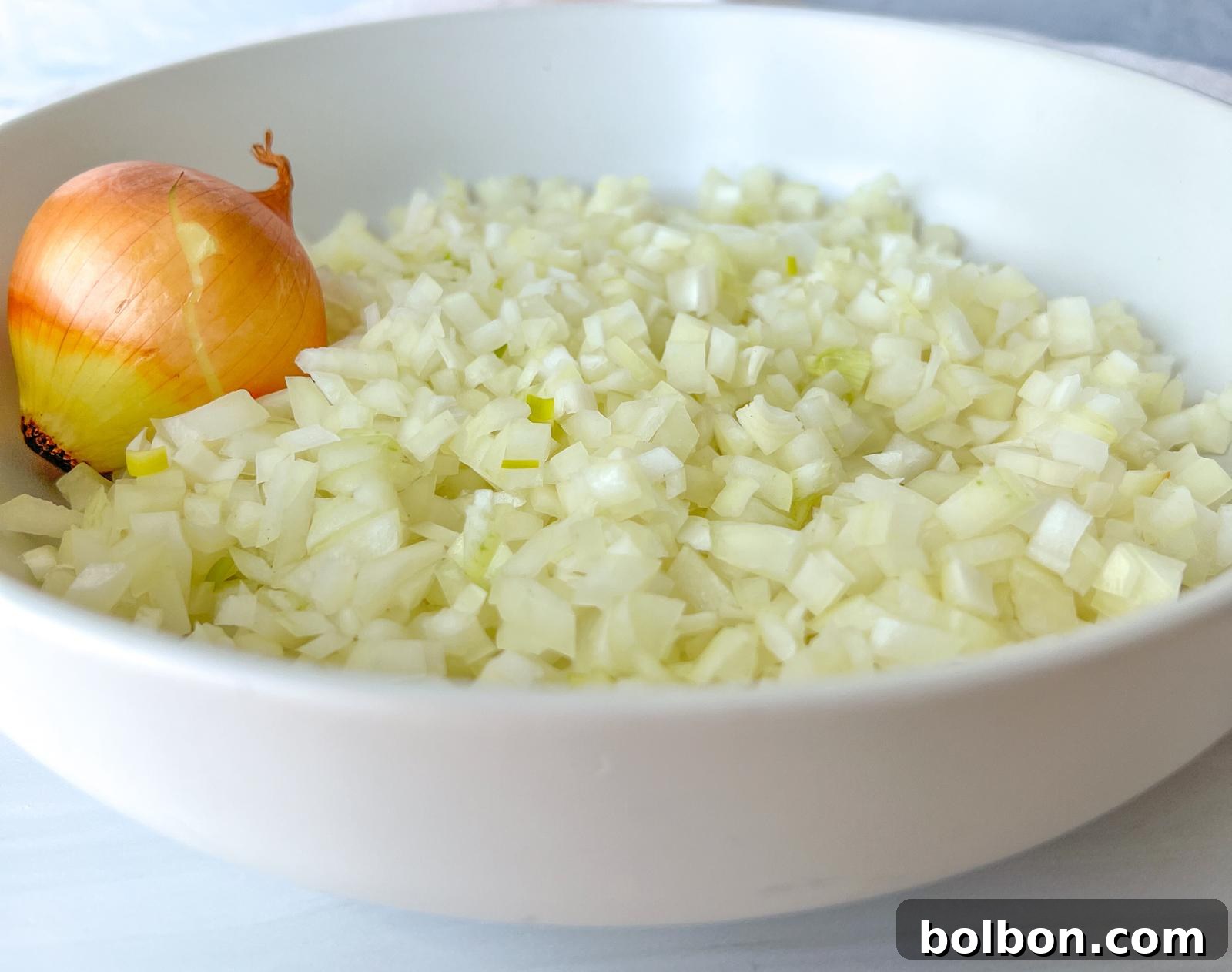
Welcome, home chef! Mastering the fundamental skill of how to dice an onion is truly a game-changer in the kitchen. If you’ve enjoyed my guides on How to Shred Lettuce or How to Dice Bell Peppers, then this tutorial on dicing onions without shedding a single tear will become your new favorite. This detailed, step-by-step guide is designed to empower you with the techniques needed to achieve perfectly uniform onion pieces effortlessly, making your cooking process more efficient and infinitely more enjoyable. By adopting a few simple yet powerful methods, you’ll be confidently dicing onions like a seasoned professional in no time, ready to infuse maximum flavor into all your culinary creations.
Master the Art of Dicing Onions: A Tear-Free Guide for Home Chefs
Why Master the Art of Dicing an Onion?
Understanding how to dice an onion is far more than just a basic kitchen task; it’s a foundational skill that elevates your cooking from good to gourmet. This method promises to make the often-dreaded task of onion preparation incredibly quick and straightforward. Once you’ve mastered this approach, it will undoubtedly become your preferred technique for adding perfectly diced onions to any meal, transforming your cooking experience into something more enjoyable and stress-free. Uniformly diced onions cook more evenly, release their flavors consistently, and significantly improve the overall presentation of your dishes. Whether you’re building the aromatic base for a rich Roasted Tomato Salsa 🍅, adding depth to hearty soups and stews, or creating a savory foundation for stir-fries and casseroles, the ability to properly dice an onion is paramount. Follow these clear and precise steps to ensure you achieve flawless, uniform pieces every single time, making every dish a masterpiece 💃🏻.
Essential Tools for Perfectly Diced Onions
Before you even make the first cut, having the right tools is crucial for success and safety when dicing an onion. Here’s what you’ll need:
🔪 A Sharp Chef’s Knife: The most important tool in your arsenal is a meticulously sharpened chef’s knife. A sharp blade allows the knife’s gravity and weight to do most of the work, gliding cleanly through the onion rather than crushing it. This precision not only ensures uniform cuts but also reduces the release of tear-inducing compounds. Crucially, a dull blade is far more dangerous as it requires more force, increasing the risk of slipping and causing an accident. Avoid small knives, such as paring knives, as their limited blade length makes it nearly impossible to achieve an even and consistent dice.
🔪 Cutting Board: A stable cutting surface is just as vital as a sharp knife. Choose a cutting board that is sturdy and provides a non-slip grip on your countertop. You can easily achieve this by placing a damp paper towel or a non-slip mat underneath your board. My personal favorite method is the damp paper towel; it’s simple and highly effective.
🧅 Onions: While I often opt for medium-sized onions for everyday cooking, this dicing technique is versatile enough for medium to large onions, and even smaller shallots. The principles remain the same, simply adjusting the scale of your cuts to match the size of your chosen allium.
Nonna’s Expert Tip for Tear-Free Dicing 🧅
To significantly reduce the release of sulfur compounds that cause eye irritation and tears, try chilling your onion. Place the whole onion in the refrigerator for about 15-30 minutes before you begin cutting. A colder onion reacts less intensely, making your dicing experience much more pleasant.
Say Goodbye to Onion Tears: Proven Strategies and Urban Legends
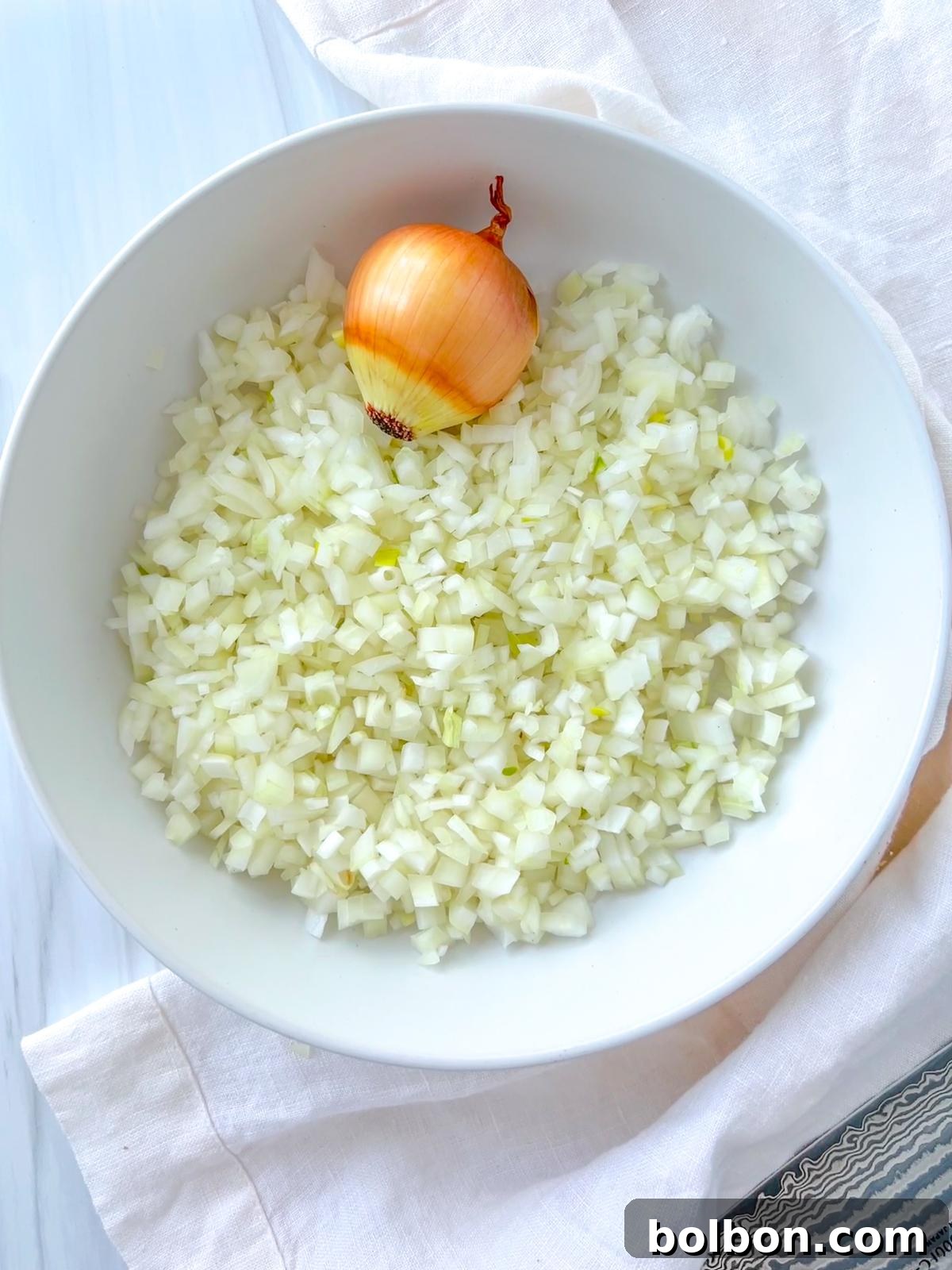
Dicing onions doesn’t have to be a tear-jerking ordeal worthy of a dramatic movie scene 😭. The infamous sting comes from sulfur compounds released when their cells are broken during slicing. Fortunately, a combination of practical tricks and a few time-honored urban legends can effectively keep the waterworks at bay. Here’s a comprehensive guide on how to cut an onion without crying:
- Chill Out Your Onion: This is arguably the most effective method. Place your whole, unpeeled onion in the refrigerator for about 30 minutes, or for a quicker solution, pop it in the freezer for 10-15 minutes. The cold temperature slows down the enzymatic reaction that releases the volatile sulfur compounds, meaning fewer irritants reach your eyes.
- Maintain a Super Sharp Knife: As mentioned, a dull blade crushes onion cells, causing more of the tear-inducing compounds to be released into the air. A precisely sharpened knife makes clean, swift cuts, minimizing cell damage and, consequently, reducing the amount of irritant fumes. A clean cut equals fewer tears.
- Choose Your Onion Wisely: Not all onions are created equal when it comes to tear-factor. Generally, stronger, more pungent varieties like red, yellow, and white onions tend to release more irritating fumes. If you’re particularly sensitive, consider opting for sweeter varieties or milder green onions (scallions), which are less likely to bring tears to your eyes.
- Improve Air Circulation: Good ventilation is key to dispersing the irritating gases. Turn on your kitchen range vent at full power, open a nearby window, or even place a small fan next to your cutting area (pointing away from your face). This helps to draw the fumes away from your eyes before they can cause irritation.
- Cut Near a Water Source: The sulfur compounds are attracted to water. Cutting onions near a running tap or even in a bowl of water can help absorb the irritants before they reach your eyes. This method can be a bit awkward, but it’s surprisingly effective for many.
- Employ Urban Legends and Quirks:
- Light a Candle: Some believe that lighting a candle nearby can help burn off some of the irritating vapors, effectively neutralizing them before they reach your eyes.
- Hold a Matchstick: Another quirky tip involves holding an unlit matchstick between your teeth while slicing. The sulfur at the match head is thought by some to absorb the onion fumes. Yes, it sounds strange, but many swear by it 😉!
- Wear Eye Protection: For those with highly sensitive eyes, or if you’re processing a large quantity of onions, dedicated onion goggles or even swimming goggles can provide a physical barrier against the irritating gases.
Expand Your Kitchen Skills: Related Tutorials
How to Shred Lettuce
10 mins
How to Poach Eggs
6 mins
How to Dice Bell Peppers
5 mins
How to Cut a Pineapple
7 mins
Step-by-Step Guide to Dicing an Onion Like a Pro
Achieving a perfect dice is a methodical process. Follow these steps carefully to ensure consistent, perfectly sized pieces:
Instructions
-
Prepare the Onion: Begin by placing the onion on your stable cutting board. Carefully cut off the stem end (the top part), but leave the root end completely intact. The root end is crucial as it holds the onion layers together, making the dicing process much easier and more controlled.
-
Halve the Onion: With the flat, cut side of the onion resting securely on the cutting board, slice the onion in half straight down through the root. You will now have two halves, each with an intact root end.
-
Peel and Position: Take one half of the onion and peel off the papery outer skin, along with any overly dry or damaged layers, exposing the fresh, clean onion beneath. Place this peeled half flat side down on your cutting board. This flat surface provides maximum stability for safe cutting.
-
Make Horizontal Cuts (Optional but Recommended): This step helps achieve a finer dice. Carefully make 3-4 horizontal cuts through the onion half, parallel to the cutting board, stopping just before you reach the root end (which should remain intact). For safety, keep your non-knife hand firmly on top of the onion, pressing it down to stabilize it. If you’re new to dicing or feel nervous, you can skip this step, but your final dice will be larger.
-
Make Vertical Lengthwise Cuts: Now, make several lengthwise cuts (from the stem end towards the root) that are closer together. The spacing of these cuts will determine the width of your final dice. Again, make these cuts as close to the root as possible without severing it entirely. Remember to keep your guiding hand in a ‘claw’ shape, protecting your fingertips.
-
Dice the Onion: Finally, turn the onion so that you can make horizontal cuts perpendicular to the ones you just made. As you slice across, uniform dice will fall away from the onion. Continue cutting until you reach the root end, which can then be discarded.
Pro Tips for Flawless Dicing and Safety
Beyond the basic steps, these professional insights will ensure your dicing is not only perfect but also safe and efficient:
- Maintain a Stable Cutting Board: Always ensure your cutting board is completely stable. Use a damp paper towel, a non-slip mat, or a board with integrated grips to prevent it from sliding on the counter. A moving board is a dangerous board.
- Master the Knife Grip: Hold your knife with a sturdy, confident grip. Your entire hand should wrap around the handle, closer to the bolster (the thick part where the blade meets the handle). Never place your index finger on top of the blade; this reduces control and can lead to accidents. A proper grip provides leverage and precision.
- Practice the “Claw” Hand Technique: When guiding the onion with your non-cutting hand, always form a “claw.” Curl your fingertips inwards, pressing your knuckles against the onion. Your knuckles will act as a protective barrier, preventing accidental cuts to your fingertips, and also serve as a guide for your blade. As you cut, slowly move your guiding hand backward, maintaining the claw shape.
- Patience is Key: When learning any new knife skill, speed is secondary to precision and safety. Go as slowly as you need to, focusing on each cut. With practice, speed will naturally follow. Remember, cooking should be a relaxing and therapeutic process, not a race.
- Achieving Different Dice Sizes:
- Fine Dice (Brunoise): For a very fine dice, make your horizontal and vertical cuts very close together, typically 1/8 inch (3mm). This is ideal for delicate salsas or garnishes.
- Small Dice: Space your cuts about 1/4 inch (6mm) apart. This is a versatile size for many recipes.
- Medium Dice: For a medium dice, aim for cuts approximately 1/2 inch (1.2 cm) apart. Perfect for soups, stews, and roasts.
Storage Solutions for Diced Onions
Proper storage ensures your prepped onions stay fresh and ready for your next culinary adventure:
Diced, chopped, or sliced onions can be stored effectively in the refrigerator. To maintain their freshness and prevent odors from permeating other foods, place them in an airtight container or a sealed ziplock bag. Stored this way, they will remain fresh and usable for up to 5 days. For longer storage, consider freezing diced onions. Spread them in a single layer on a baking sheet, freeze until solid, then transfer to a freezer-safe bag or container. They can last for several months and are perfect for adding directly to cooked dishes.
Elevate Your Cooking: Recipes Featuring Perfectly Diced Onions
Diced onions are a fundamental ingredient that forms the aromatic backbone of countless dishes across global cuisines. Once you’ve mastered dicing, you’ll find endless opportunities to incorporate them:
- As a foundational aromatic, adding depth and sweetness to hearty dishes like Lentil Soup or a robust Healthier Chili.
- Providing a crisp texture and pungent flavor as a component in a fresh Simple Green Salad, adding zest and complexity.
- You’ll want exquisitely fine diced onions to provide a delicate crunch and tangy bite in refreshing seafood dishes like Shrimp Ceviche 🦐.
- A crucial ingredient in various egg preparations, bringing flavor and body to savory dishes such as my wholesome Zucchini Egg Bake or the popular Copycat Starbucks Egg-Bites.
- Perfect for building flavor in stir-fries, curries, sauces, and almost any savory dish that starts with a sautéed aromatic base.
Frequently Asked Questions About Dicing Onions
A sharp knife cuts cleanly through the onion cells, minimizing the release of syn-propanethial-S-oxide, the sulfur compound responsible for tears. A dull knife crushes the cells, releasing more of these irritants, making for a tearier and less efficient dicing experience. Sharp knives are also significantly safer as they require less force and are less likely to slip.
Absolutely! This universal dicing method works beautifully for various onion types including yellow, white, red, and even smaller shallots. The technique remains the same; you simply adjust the scale of your cuts to match the size of the onion. Yellow onions are great all-purpose, red onions add color and mild bite, and sweet onions are fantastic for raw applications or when you want less pungency.
The “claw” hand technique involves curling your fingertips inward and pressing your knuckles firmly against the vegetable you’re cutting. Your knuckles act as a protective guide for the knife blade, ensuring your fingertips stay safely tucked away from the sharp edge. This technique is paramount for safety, preventing accidental cuts, and also helps guide the knife for more precise, even cuts. As you cut, progressively move your guiding hand backward while maintaining the claw shape.
A stable cutting board is essential for safety. My favorite method is to place a damp paper towel or a thin, non-slip silicone mat underneath the cutting board. This creates friction, preventing the board from moving around on your counter. Many cutting boards also come with built-in rubber feet for added stability. Always ensure your board is secure before beginning any knife work.
Yes, this method is adaptable for various dice sizes. For a fine dice (brunoise), make your initial horizontal and vertical cuts very close together, about 1/8 inch (3mm). For a small dice, aim for 1/4 inch (6mm) spacing. For a medium dice, space your cuts approximately 1/2 inch (1.2 cm) apart. The key is consistent spacing for uniform pieces.
How To Dice an Onion
Facebook Share
Rate Recipe
Print Recipe
Tutorials and Hacks
The Modern Nonna
5 minutes
5 minutes
Video
Equipment
Instructions
- Using a chef’s knife, cut a small portion off the front (stem) end of the onion, ensuring the root end remains completely intact.
- Place the onion flat-side down on a cutting board and slice it in half, cutting straight through the root.
- Take each half and peel off the top skin layer. Position the peeled onion half flat-side down. Optionally, make 3-4 horizontal cuts into the onion, being very cautious and stopping just before the root end. Skip this step if you are uncomfortable.
- Next, make lengthwise cuts, closer together, always cutting towards but not through the root end. The spacing of these cuts will determine the size of your dice.
- Finally, begin dicing the onion by making horizontal cuts perpendicular to the previous lengthwise cuts. Continue until you reach the root end, which can then be discarded.
Notes
- Tear-Free Method: For a less teary experience, chill the onion in the refrigerator for 15-30 minutes before cutting. This helps to minimize the release of sulfur compounds that cause eye irritation.
- Sharpness Matters: The key to effortless and safe dicing is a sharp chef’s knife. A dull blade can slip and cause accidents, and it also crushes onion cells, releasing more tear-inducing fumes.
Additional Info
Tutorials and Hacks